ECOINVENT verifies ICL bromine as world-leading low-carbon bromine
ECOINVENT verifies ICL bromine as world-leading low-carbon bromine
In this article, we discuss the importance of carbon footprint transparency and the empowering role of low-carbon footprint bromine in today's changing industrial landscape.
ICL has the world's largest bromine production capacity, providing many industries worldwide with both elemental bromine and bromine compounds. But in today's world, where vast production and sustainable practices converge, we at ICL are focused not only on advanced, global-scale production, but also on leaving a low carbon footprint.
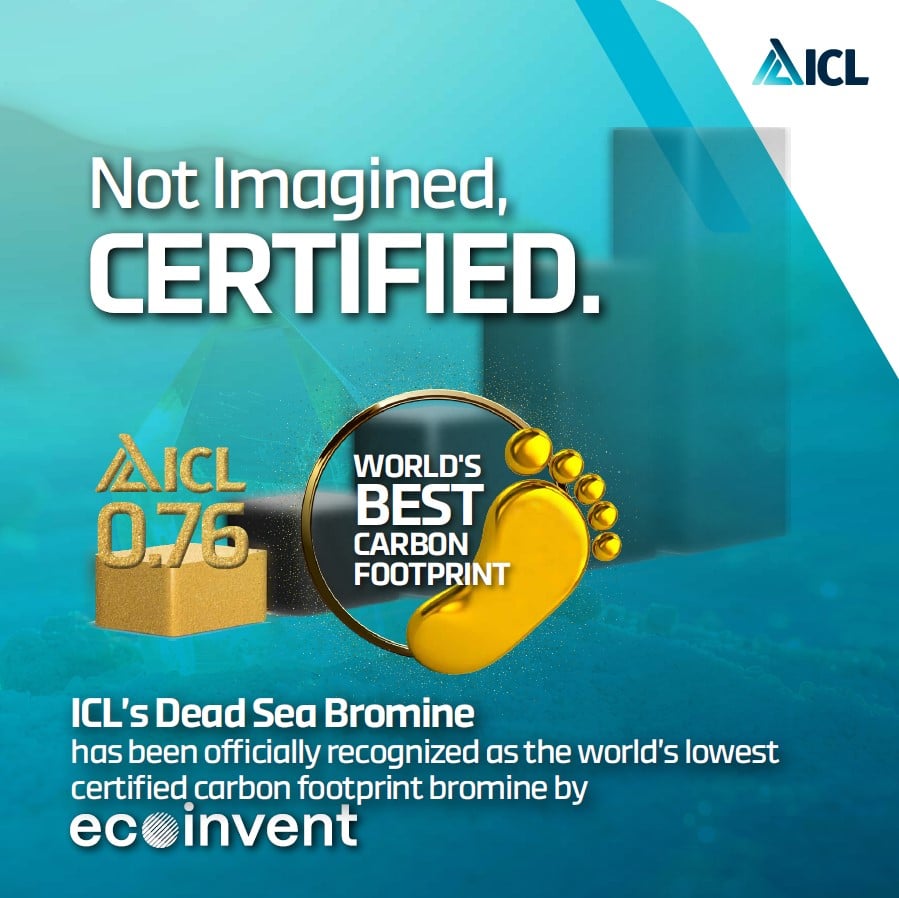
For this reason, we commissioned ECOINVENT, a world-leading high-quality environmental data provider, to assess ICL bromine's environmental footprint – providing the organization with all the necessary data to conduct a reliable measurement of environmental impact. In October 2025, ECOINVENT delivered its assessment; based on the analyzed data, our bromine was officially verified as the world’s lowest carbon footprint bromine.
The ECOINVENT assessment – as well as fresh data regarding bromine production from the dead sea – was released as part of the organization's environmental impact database Version 3.12, which contains the most up-to date life cycle inventory data for a wide range of industries, from agriculture and electronics to chemicals, plastics, textiles and transport.
Why carbon footprint transparency matters
ECOINVENT's assessment and data update regarding ICL bromine matters not only because of its results, but also because of what it signifies: transparency.
In recent years, industries worldwide are facing increased pressure to decrease their environmental impact. Within this framework, carbon footprint transparency is an important facet often viewed not only as a voluntary act, but as a foundational requirement. Many bromine producers, in particular, are realizing just how important credible and verifiable carbon footprint assessments are to trust-building processes with downstream industries, regulators, investors, and key decision-makers.
Transparent reporting is the basis for accurate measurements of bromine-related emissions across all production stages, from raw material sourcing through processing and delivery. Without consistent access to these forms of operational data, assessments run the risk of being incomplete, inaccurate, and, in the end, undependable.
Supplying recognized assessment organizations with access to accurate data provides many benefits. For starters, it aligns environmental footprint calculations with standardized methodologies. This, in turn, helps create a fair comparability across bromine suppliers and from different regions.
Transparency also serves as a change catalyst, signaling a broad industry shift from generalized sustainability claims toward measurable performance indicators, encouraging the entire industry to target avoidable emissions and align with best practices and identify avoidable emissions and pursue reduction objectives. When it comes to the bromine industry, transparency is more than simple reporting – it is a stimulant for collective-level accountability.
Low carbon footprint bromine: The main advantages
Using bromine with low carbon footprint matters because bromine is widely used on a global scale. Bromine can be found in flame retardants, water treatment solutions, intermediates for pharmaceuticals, energy storage solutions and more. Humanity relies on bromine, and therefore using low carbon footprint bromine contributes directly to climate change mitigation. Low-carbon bromine reduces the industry's contribution to greenhouse gas concentrations. Oftentimes, emission reduction coincides with improved energy efficiency and resource optimization.
Low-carbon bromine also enables tangible advantages for downstream industries, both in the present and the future. Today, manufacturers face growing pressure to reduce their Scope 3 emissions; using verified low-carbon bromine assists them in achieving their sustainability and ESG reporting goals.
Looking forward, regulatory frameworks are likely to become stricter, especially when it comes to carbon pricing mechanisms, product-level environmental declarations and disclosure requirements. Using low-carbon bromine may help companies from diverse industries facilitate seamless regulation compliance while maintaining a steady foothold in markets practicing high sustainable standards. In the future, it may even become a prerequisite for participation in certain operational or manufacturing processes.
By prioritizing transparent carbon footprint reporting and investing in emissions reduction, bromine producers can play a pivotal role in supporting decarbonization across multiple industries – while strengthening their own resilience in a rapidly changing regulatory and commercial environment.
Applications: Low carbon bromine in action
At ICL, we are proud to leverage our commitment to sustainability to create low-carbon footprint bromine that supports many industries.
Sourcing bromine from the Dead Sea, our vast portfolio of high-quality bromine-based solutions include sources for pharma applications, advanced brominated flame retardants, mercury oxidization from emission gasses in the energy industry, biocides for industrial microbial treatments, and more.
Enabling sustainable industrial growth
Low-carbon bromine is no longer a niche differentiator. It is becoming an enabler for sustainable industrial growth. For more information about our low-carbon footprint bromine and solution portfolio, please contact: [email protected]
We would love to hear from you!